Mr. Mawhinney
The Plot Against AmericaMr. Mawhinney is a Kentucky farmer who hosts Sandy Roth on his farm, where daily labor and food from the household’s own animals and gardens shape Sandy’s account of his stay. Though the novel gives little direct characterization, the farm emerges through the concrete details Sandy remembers: home-smoked bacon, carefully aged ham, fieldwork, and a tenant farmer whom Mr. Mawhinney regards as exceptionally capable.
The Farm and Its Household
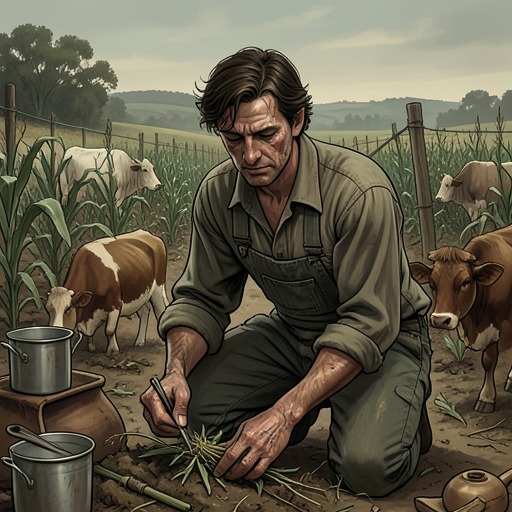
Sandy describes Mr. Mawhinney as someone who smokes his own bacon in a smokehouse and makes ham according to a family recipe. The ham, he says, must hang to age for a year before it is worth eating. The household also grinds its own sausage, sometimes serving it in place of bacon. These practices make the farm a place of production as well as residence: food is raised, prepared, and preserved there.
The household’s meals impress Sandy with their abundance and freshness. Mrs. Mawhinney, who is from Georgia, makes pancakes with bacon for breakfast; on Sundays the family also eats eggs from its own chickens, which Sandy describes as nearly red at the center. His recollections convey the farm less through abstract praise than through the daily presence of food made close to its source.
Work in the Fields
Sandy’s account also stresses the routine of farm labor. The daytime heat gives way to a midday break indoors, with tomato-and-mayonnaise sandwiches and plenty of lemonade, before the workers return to the fields. Sandy and Orin Mawhinney weed a vegetable garden and work alongside hired hands, including Black day laborers. They weed both corn and tobacco, tying Sandy’s stay to the farm’s agricultural work rather than presenting it as an uninterrupted pastoral holiday.
Among the workers is Randolph, a tenant farmer who had risen from hired hand. Mr. Mawhinney considers him a first-rate farmer. That detail gives Sandy’s picture of the farm a social dimension: its work is shared across different positions, and Mr. Mawhinney’s assessment of Randolph marks him as an experienced judge of agricultural skill.
Sandy’s Account and the Farm’s Place in the Plot
The farm is presented primarily through Sandy’s recollections, in a conversation with Philip about what he ate and how he spent his days. His emphatic descriptions of bacon, ham, sausage, and fresh eggs make the stay memorable, while his account of weeding corn and tobacco grounds that memory in work. Mr. Mawhinney is thus drawn indirectly, through the food he makes, the farm he runs, and the worker whose ability he recognizes.
Later, when Sandy is asked about his time on the farm, he confirms that he worked with white burley tobacco. Aunt Evelyn had prepared him for the question the previous evening, and his answer that he learned about his country earns her visible approval. Mr. Mawhinney’s farm therefore becomes more than the setting for Sandy’s rural experience: it is also the place from which Sandy carries a politically useful account of what he has learned.